New maps in seven states face voter reality checks on Election Day
Mid-decade redistricting in states like Texas and Ohio created new districts, but analysts say historical voting patterns may not align with the intended political advantages.
By Sakura Novak ·
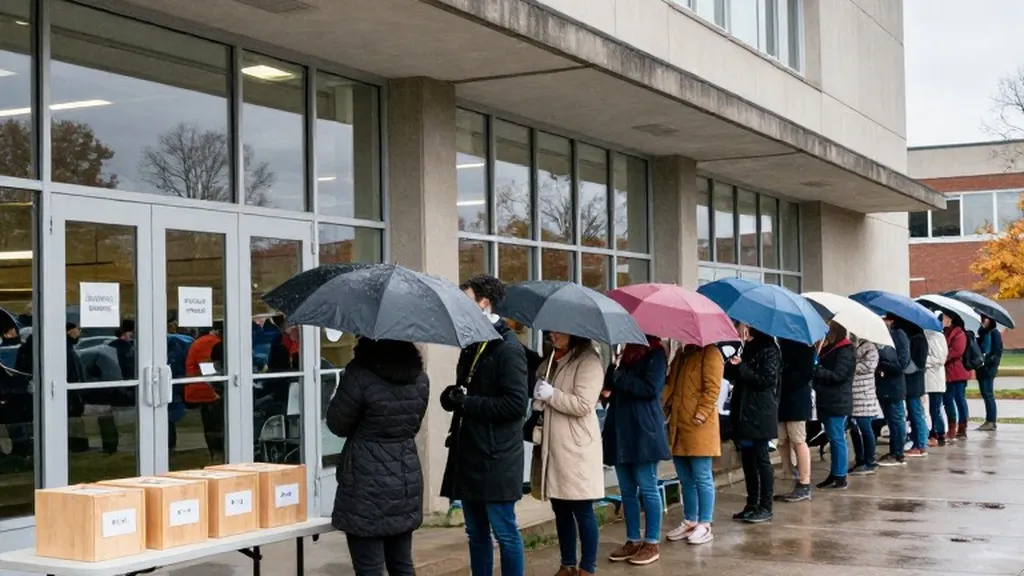
On this Election Day, Tuesday, November 3, 2026, voters in seven states are casting ballots under congressional maps that have been redrawn since the last midterms. These new boundaries apply in California, Florida, Missouri, North Carolina, Tennessee, Texas and Ohio. The redistricting process was intended to reshape political dynamics, yet early signals suggest the districts may not vote as their designers anticipated. This creates a layer of uncertainty in the midterm elections that are deciding control of Congress for the final two years of President Donald Trump's second term.
The House of Representatives is fully up for election, with all 435 seats on the ballot. Republicans currently hold 218 seats, while Democrats hold 214, with one independent and vacancies. Democrats need a net gain of three districts to secure a majority, whereas Republicans can lose no more than two. 46 districts are considered battlegrounds. Of these, 25 are held by Democrats and 21 by Republicans. The new maps have altered the competitive landscape, particularly in states where the lines were drawn with specific partisan goals in mind.
In Texas, the new map has been a focal point for both parties. The state is using a new congressional map for the first time in this cycle. Historical data shows that 21 districts held by Democrats voted for President Trump in 2024, while nine Republican-held districts voted for former Vice President Kamala Harris. This divergence suggests that the new lines may have created districts where the party affiliation of the incumbent does not perfectly match the presidential lean of the area. Voters in these areas are deciding whether to stick with their local representative or shift toward the party that aligns more closely with their recent presidential choice.
Ohio presents a similar complexity with its new congressional map. The state is also using updated boundaries for this election. The presence of a new map in Ohio adds a variable to the Senate race as well, where a special election is taking place for the remainder of the term JD Vance was elected to in 2022. The interplay between the House and Senate races in these states means that the new maps could influence the overall balance of power in Washington. Analysts note that while the lines were drawn to favor one side, voter behavior often follows local issues and personal voting habits rather than strict geographic alignment.
Florida and North Carolina also feature new congressional maps that are being tested today. In Florida, a special Senate election is underway for the remainder of Marco Rubio's term. The state's new House districts are being scrutinized to see if they perform as predicted. In North Carolina, the new map affects the House races in a state that is considered a key battleground. One or two seats could tip either chamber, making the performance of these new districts critical. Voters in these states are weighing the new boundaries against their economic concerns, with many citing high prices as a primary motivation.
Missouri and Tennessee have also adopted new congressional maps for this cycle. In Missouri, the redistricting process has created new competitive districts that may not replicate the historical voting patterns of the old lines. Tennessee's new map similarly introduces changes that could affect the outcome of the House races. Republicans were bracing to lose the House and fighting to hold the Senate, with the new maps serving as a tool to mitigate potential losses. However, the effectiveness of these maps is still being determined by the votes cast today.
The mood in these seven states is marked by a sense of caution and anticipation. More than 57 million people had already voted as of Monday, surpassing early vote totals from four years ago in many closely watched states. This high level of early voting suggests that voters are engaged in deciding the fate of these new districts. The AP-NORC polling indicates that 35% of U.S. Adults approve of Trump's job performance, while about 7 in 10 say the country is heading in the wrong direction. These national sentiments are likely to influence how voters in the newly drawn districts cast their ballots, potentially undermining the strategic goals of the redistricting.
The financial aspect of the election also highlights the importance of these new districts. The 2026 elections are likely to be the most expensive in history. Republican committees outraised and outspent Democratic committees, with 88.1% of Republican general election TV ad spending going to states and districts Trump won in 2024. This heavy investment in areas that may not align perfectly with the new district lines suggests that both parties are betting on the possibility that the new maps will perform as intended. However, the data on presidential voting patterns in these districts indicates that there is a risk of misalignment between the map's design and the actual voter base.
As polls close in these states, the question remains whether the new congressional maps will yield the results their creators hoped for. The districts in California, Florida, Missouri, North Carolina, Tennessee, Texas and Ohio are being decided by voters who may not strictly adhere to the partisan leanings of the new boundaries. The outcome of these races will provide a clear indication of whether mid-decade redistricting is an effective tool for shaping political outcomes or if voter behavior remains the dominant force. The results will help determine who controls Congress and, by extension, the legislative agenda for the remainder of the current presidential term.