Tennessee execution team warned of ruptured veins before lethal injection
A court filing details the chaotic IV placement process that left Christa Pike hospitalized after surviving two doses of pentobarbital.
By Sakura Novak ·
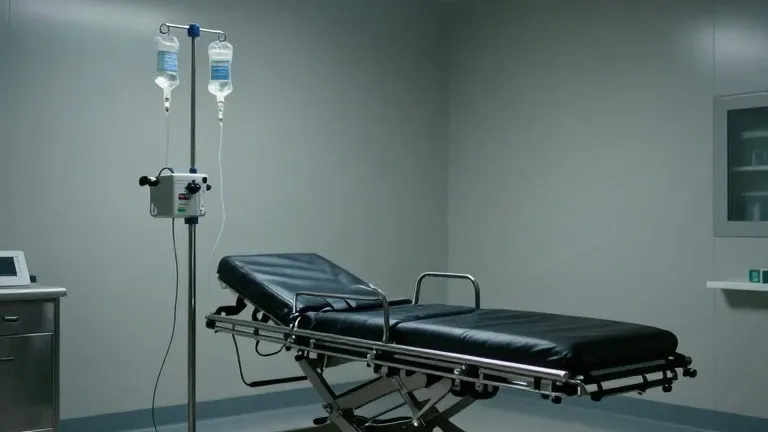
Christa Pike, 50, spent several days on a ventilator after surviving an attempted execution in Tennessee. The delay in her medical treatment, which occurred after she survived two lethal doses, stemmed from a chaotic effort by medical staff to establish intravenous access. A court document filed on Thursday provides the most detailed account of that struggle, revealing that the team warned of vein damage before administering the final drugs.
The filing, submitted by attorney Randy Spivey, describes a procedure that relied on approximately 10 needle insertions across both of Pike’s arms. The state’s protocol requires two IV lines for a lethal injection. The team struggled to establish a functional line in Pike’s left arm for nearly an hour. Spivey noted that the medical staff had difficulty pushing saline through the final site, indicating a mechanical failure in the delivery system.
The timeline in the document shows the team began attempting to place the IVs at 6:34 p.m. A line was set in Pike’s right arm within six minutes. The left arm proved far more difficult. Pike, who was wincing and grimacing as needles were moved, suggested the team look in her upper arm for a usable vein. Despite this, the process took nearly 60 minutes to complete.
During the procedure, team members voiced uncertainty about the condition of the veins. At 6:57 p.m., one member stated a vein might be blowing, though two others could not confirm it. A later needle appeared severely bent upon removal. By 7:07 p.m., a team member declared, 'I think it's blown.' The team finally decided at 7:13 p.m. that an IV was successfully placed in her left arm.
Phone calls to the execution chamber began roughly five minutes after the IV was deemed secure. Spivey reported that staff pushing the drug from an adjoining room repeatedly asked the IV team to check Pike’s left arm. It is unclear exactly when the pentobarbital entered the lines. At 7:34 p.m., Pike stated, 'I feel like my arm is about to bust. It burns.'
For the next 30 minutes, Pike strained, flinched, and moved her head while appearing to struggle for breath. Spivey was denied immediate access to a phone in the witness room and instead had to walk a seven-minute route through the facility to call colleagues. At 8:22 p.m., he requested the execution be stopped, noting that a third dose was not authorized. He told the deputy attorney general that Pike required immediate medical care.
Pike was convicted in 1995 for the stabbing death of classmate Colleen Slemmer. She was 18 at the time of the crime and became one of the youngest women sentenced to death in the state. Tennessee’s protocol mandates a second dose of pentobarbital if the first does not cause death but does not specify procedures for a person who survives the second injection.
After the attempt on September 30, Pike was placed on a ventilator. Her attorneys did not initially expect her to survive. She has since regained consciousness and returned to prison after being discharged from the hospital. The filing was submitted in a separate case where death row inmates are challenging the state’s lethal injection methods.
Kit Thomas, an attorney representing those inmates, said, 'Our predictions about the likelihood of botched executions have come true, and will continue to come true, without substantial change.' An ambulance arrived at the hospital at 9:14 p.m. that night, more than two hours after the IV was first attempted.
The medical team performed life-saving measures on Pike after being notified of her condition. The specific details of her care during the initial hours of her survival are outlined in the new court document, which highlights the gap between the state’s written protocol and the practical realities of administering the drugs.