Tennessee Execution Pause: Expert Panel Cites Malpractice in Failed Injection
Medical specialists argue that the team's failure to secure a vein for Christa Pike before administering a fatal dose of pentobarbital constitutes medical malpractice.
By Sakura Novak ·
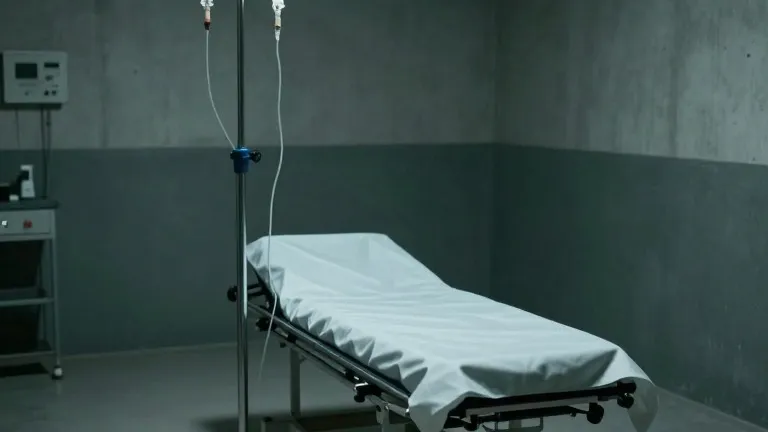
Tennessee has suspended all executions pending a review after medical experts labeled the failed lethal injection of Christa Pike as medical malpractice. The state halted operations following legal proceedings on Thursday that revealed new details about the September 30 procedure. Experts stated that the conduct observed in the death chamber would be considered malpractice in a standard hospital setting.
Randy Spivey, Pike's attorney, filed a detailed chronology of events inside the execution chamber. His account describes four unidentified members of the IV team struggling for nearly an hour to secure a line in Pike's arms. The team used approximately 10 needles and repeatedly poked the inmate without success. At several points, personnel expressed concern that her veins might have blown.
Jonathan Groner, an emeritus professor of clinical surgery at Ohio State University, described the timeline as showing no plan and no one in charge. He noted that the label on the pentobarbital vial instructs staff to stop the infusion immediately if a patient reports pain. Pike grimaced several times and stated her arm was really burning, according to the account.
At 7:05 p.m., roughly 30 minutes into the process, a team member requested a 24-gauge needle and moved it around extensively. Joel Zivot, a professor of anesthesiology and surgery in Atlanta who provided expert testimony, identified this catheter size as typically used for infants. Under Tennessee protocol, the team intended to inject 50cc of pentobarbital into each arm, totaling 5 grams. Zivot stated there was no way to push a 50cc syringe through such a small catheter without blowing the vein. A team member declared they thought the vein was blown at 7:07 p.m.
The team attempted to locate a vein using ultrasound, a technique Groner said requires extensive specialist training and up to 20 actual procedures to perform smoothly. He observed that the team did not know how to use the equipment. Saline was pushed through the line with difficulty at 7:23 p.m., which Groner called a flashing red light. One minute later, at 7:24 p.m., the team concluded the IV was set and began the procedure. Groner noted that no clinician would administer a caustic drug through a line that did not flush easily.
Pike's legal team had warned the state multiple times before the attempt that she had exceptionally small and compromised veins. Zivot listed several serious failings, including a poorly written protocol and the use of technology the team may not have had permission to utilize. Pike, who was sentenced to death for the 1995 murder of classmate Colleen Slemmer, spent several days on a ventilator after the failed execution. Her lawyers assumed she was brain-dead, but she returned to her prison cell after 10 days in the hospital and can now talk and walk.
Groner called lethal injection a medical charade, stating that the ultimate penalty is death, not torture followed by death. Zivot said the team pressed on when they should have stopped, noting that medicine is obsessed with safety, accountability, and training, none of which were visible in the execution chamber. The state has paused all executions as the case prompts a national reckoning over the death penalty.
More Politics · World news · Report a business · Got a Story?