Ancient light rules out giant black holes as main dark matter source
A new study using cosmic microwave background data indicates that black holes exceeding 100 billion solar masses cannot constitute a major share of the universe's invisible mass.
By Kwame Silva ·
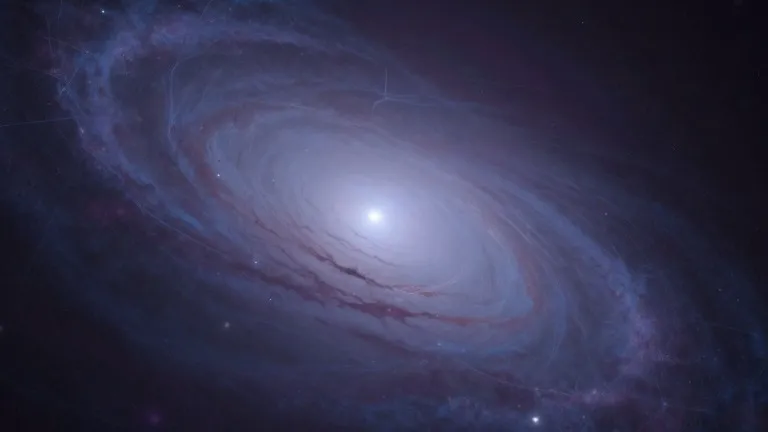
The invisible substance that holds galaxies together is not made of the universe's largest black holes. A study released on October 23 concludes that objects with masses exceeding 100 billion times that of the sun cannot account for a substantial portion of dark matter.
Dark matter is estimated to comprise approximately five-sixths of all matter in the cosmos. Scientists introduced the concept decades ago to explain why galaxies do not disintegrate despite their rapid rotation. Because these invisible objects are massive and difficult to observe, they have been a long-standing candidate for the identity of dark matter.
The research team, including Christopher Gerlach from the Mainz Institute for Theoretical Physics in Germany and Antonio Iovino from New York University Abu Dhabi, focused on "stupendously large black holes." These are objects heavier than 100 billion solar masses. While no such object has been detected yet, the known record holder weighs about 36 billion solar masses. The researchers wanted to test if these rare, massive entities could still make up a significant fraction of the total dark matter.
Gerlach noted that if dark matter were concentrated in a few gigantic objects rather than spread out like fine dust, the universe would appear grainy on large scales. To check for this graininess, the team analyzed the cosmic microwave background. This radiation is the light released from the early universe, specifically a snapshot from 380,000 years after the Big Bang when atoms first formed and allowed light to travel freely.
Iovino explained that the temperature of this background radiation varies by about one part in 100,000 from place to place. These variations reveal how matter was distributed in the infant universe. The analysis found that the background lacks the specific grainy pattern that would be produced by stupendously large black holes.
Nicholas Leister, also at the Mainz Institute for Theoretical Physics, stated that the absence of this pattern means these black holes cannot be a significant part of dark matter. The authors clarified that the result does not prove such black holes do not exist, only that they are not a primary component of the invisible mass. The findings are scheduled for publication in Physical Review Letters on October 26.