Seabirds Lose Their Compass After Long Ocean Flights
New research indicates that Manx shearwaters experience internal time shifts that distort their solar navigation while crossing the Atlantic.
By Sakura Novak ·
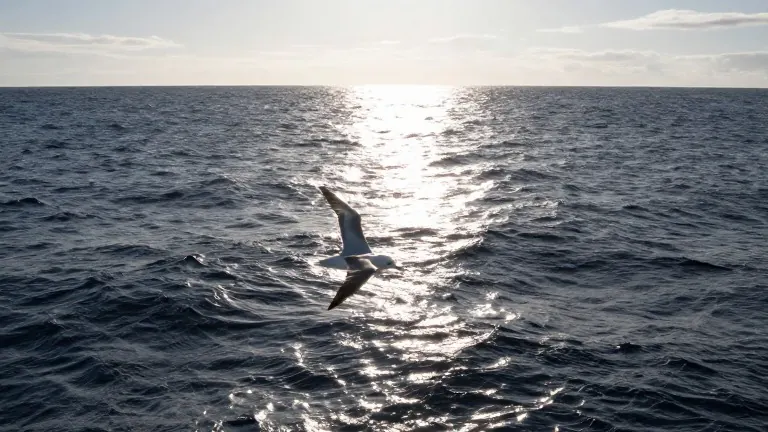
Manx shearwaters flying across the North Atlantic are not just battling wind and waves. A study published in Science this week reveals that these seabirds suffer from jet lag, a phenomenon previously associated with human travelers. The internal time shift caused by their long-distance flights interferes with their ability to use the Sun for navigation, skewing their compass as they head home.
Patrick Lewin, a behavioral and sensory ecologist at the University of Oxford and the lead author of the study, describes the birds as medium-sized, roughly the size of a pigeon. They feature white bellies, black backs, and very long wings. While closely related to albatrosses, they nest in burrows on coastal islands around the North Atlantic. The majority of the population breeds in the United Kingdom and Ireland, with approximately half residing in Wales.
These birds travel from their nesting sites to feed in waters ranging from a few dozen kilometers to more than 1,000 kilometers into the Atlantic. To return to their colonies, they likely use a map sense, potentially based on smell, to determine their location. Once oriented, they rely on the Sun to set their direction of travel.
Navigating by the Sun requires a precise internal clock because the Sun moves across the sky throughout the day. Lewin explains the mechanics of this process. A bird traveling south at sunrise must fly 90 degrees clockwise from the Sun. By midday, it must fly straight toward the Sun. At sunset, the direction shifts to 90 degrees anticlockwise from the Sun. This constant adjustment demands an accurate sense of the time of day.
The study demonstrates that the internal clocks of Manx shearwaters are not perfectly synchronized with their new local environments after long flights. This desynchronization creates a measurable error in their navigation. The birds effectively jet-lag themselves, causing their directional headings to drift as they attempt to fly home over the open ocean.
The findings offer a concrete example of how biological rhythms impact spatial orientation in animals that travel across multiple time zones. The research highlights a specific mechanical link between circadian disruption and navigational accuracy in a species that depends on solar cues for survival.
The study provides new data on the sensory ecology of long-distance migratory birds. It establishes that the cost of long-haul flight includes a temporary degradation in navigational precision due to internal biological timing issues.