California Ballot Measure 40 Targets Wealth of 200 Residents
State residents vote on a one-time five percent levy to fund medical care, a policy that has divided high-net-worth individuals and political leaders.
By Sakura Novak ·

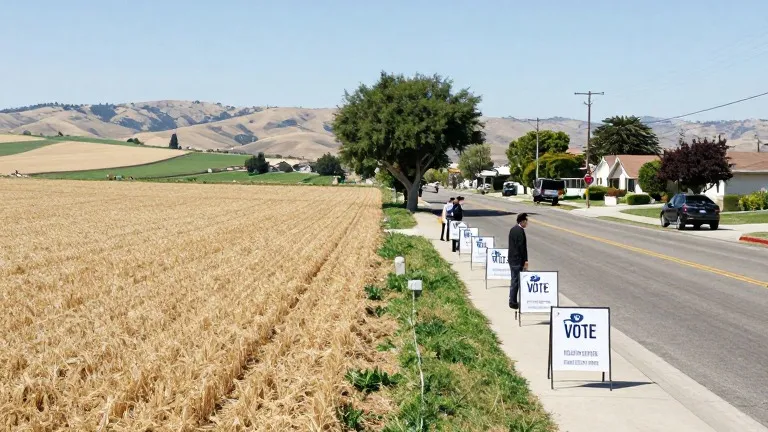
California residents will soon vote on a historic tax levied against the state's wealthiest families.
Ballot Proposition 40 seeks to collect a single five percent charge on the net assets of every individual in the region whose wealth exceeds one billion dollars. Approximately 200 people currently qualify for this assessment. If the measure passes, the government aims to generate 100 billion dollars in revenue to offset federal reductions in medical funding. These cuts stem from national legislation passed by the Trump administration. Advocates describe the initiative as a temporary bridge while a permanent financing model is developed. Suzanne Jimenez, a union leader, warned that inaction risks a collapse in the state's medical infrastructure.
The state holds the largest economy in the nation and ranks fourth globally. Its output surpasses that of the United Kingdom and India. Despite this economic scale, California has the highest number of homeless residents in the country and displays one of the sharpest disparities in income distribution. Academic observers view the proposal as a novel attempt to tax the extreme upper tier of the wealth spectrum. Francesco Trebbi, a policy professor at the University of California, Berkeley, believes this may be the first such tax of its kind in history. The legislation targets a specific percentile that has rarely been subjected to direct state-level wealth taxation.
Governor Gavin Newsom, whose term is concluding, has emerged as a leading opponent of the plan. He argues that the new burden could encourage wealthy residents to relocate and take their income tax revenue with them. Financial data suggests some billionaires have already begun to move. At least six high-net-worth individuals have reportedly left the state. This group includes Google cofounders Larry Page and Sergey Brin. Venture capitalist Peter Thiel and former Uber executive Travis Kalanick are also among those who departed. Don Hankey, who founded the Hankey Group, stated that the proposal made him feel unwelcome despite the employment his firms provided. He relocated to Nevada as a result.
Major tech figures are closely monitoring the potential financial impact. Mark Zuckerberg, head of Meta, informed his board last month that he was considering changing his primary address. The company, which maintains its headquarters in the state, arranged a new stock agreement to give him additional shares. This move is intended to help offset potential losses if the tax is enacted. He could owe up to 12.5 billion dollars. Andy Fang, who helped launch DoorDash, described the measure as foolish in public statements. A September poll conducted by the Los Angeles Times and the Berkeley Institute of Governmental Studies found that 45 percent of likely voters support the tax, while 42 percent oppose it. Thirteen percent remain undecided. A simple majority is required for passage.
Supporters argue that the tax reflects a broader desire to address economic imbalance. Jensen Huang, chief executive of Nvidia, told a CBS interviewer that he is comfortable with paying taxes proportional to his earnings. Senator Bernie Sanders spoke at a Los Angeles rally, asserting that billionaires believe they possess a divine right to govern. He predicted that voters would deliver a strong message on November 3. The initiative fits into a national trend where states are exploring new revenue streams. Washington state voters are currently weighing a nine percent tax on income exceeding one million dollars.
Internationally, wealth taxes have declined in frequency. Dr. Kristian Niemietz of the Institute of Economic Affairs notes that only Spain, Norway, and Switzerland maintain such levies. He argues that these taxes often create more problems than they solve. In the United States, inequality has reached its highest level in over thirty years. The top one percent of households held nearly 32 percent of total wealth in the third quarter of 2025. Surveys indicate that 72 percent of Californians believe the gap between the rich and the poor is growing. A similar share believes the state government should take greater action. Trebbi suggests the measure is driven by anti-elite sentiment and is less about the specific details of the tax than about rebalancing the economic scale.
Voters will have the final say in determining the state's approach to medical funding. The outcome will signal whether California becomes the first US state to implement a broad-based wealth tax on its most affluent residents.
More Politics · World news · Report a business · Got a Story?