10,000 Residents: The Hard Cap on Lunar Cities Driven by Water Scarcity
Harvard physicists calculate that moon water limits a sustainable population to 10,000, far below million-person city plans.
By Sakura Novak ·
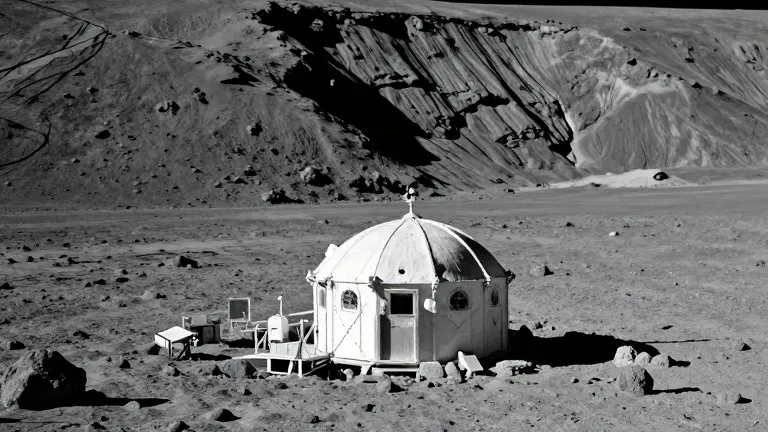
Moon water reserves may limit sustainable lunar settlements to 10,000 residents, new research indicates. The finding challenges executive plans for massive lunar cities.
Martin Elvis of Harvard’s Smithsonian Astrophysical Observatory and Jonathan McDowell of Durham University analyzed lunar resources in a paper published in Frontiers in Space Technologies. They examined power and water availability on the moon.
The researchers found that power generation is not a limiting factor. Solar and nuclear energy sources could support a population of one million people. Water availability presents a steeper constraint.
Estimates suggest approximately one billion tonnes of water exist in permanently shadowed polar regions. Elvis and McDowell calculated that this supply would sustain one million people for about 100 years, assuming 98% recycling rates similar to the International Space Station.
Elvis described the total volume as comparable to a Central Park-sized aquarium filled to the base of the Statue of Liberty. He called it a small lake insufficient for a large city. A settlement of 10,000 people, however, could remain sustainable for centuries under the same assumptions.
Elvis noted that the one billion tonne estimate may be 20 to 30 times too high. He suggested only one percent of the water is likely recoverable, which would reduce the sustainable duration for a million-person city from 100 years to one year.
Gordon Osinski, a planetary geologist at Western University, stated that satellite measurements contain uncertainties. He described the water as potentially resembling Arctic permafrost, with sub-millimetre ice crystals mixed into soil. McDowell said the results should not discourage exploration but rather clarify engineering requirements.