NFPA advises EV owners to treat flooded cars as accidents after king tides
Saltwater exposure can cause battery failures hours or weeks after the water recedes, according to new fire safety guidance for South Florida.
By Lina Lewis ·
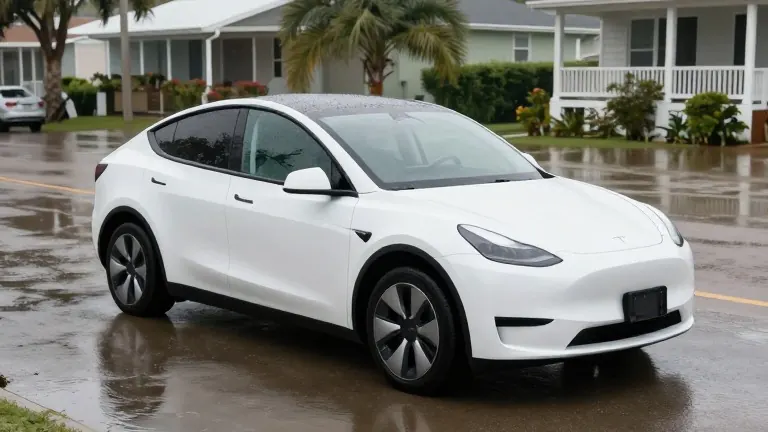
For electric vehicle owners in South Florida, the end of a high tide does not necessarily mark the end of the danger. The National Fire Protection Association, or NFPA, has issued specific guidance on how to handle electric cars that have been submerged in saltwater. The agency warns that the water can leave behind conductive residues that may trigger battery failures long after the vehicle is dry.
The primary concern involves the high-voltage lithium-ion battery pack. When saltwater penetrates these components, it can create conductive paths that lead to short circuits. The salt also accelerates corrosion inside the battery housing. This internal damage can eventually lead to a condition known as thermal runaway, where the battery heats up uncontrollably and may produce fire, gas, or an explosion.
One of the most difficult aspects of this risk is the timing of the failure. The NFPA states that there is no specific window in which a thermal reaction might occur after a flood. A car could fail hours, days, or even weeks after the water has receded. This means a vehicle that looks normal and dry is not automatically safe. Owners should not assume the car is ready to drive just because the flooding has ended.
The NFPA recommends that any electric vehicle that was submerged be treated as if it had been in a severe accident. Owners should not enter the vehicle, attempt to start it, or drive it. Instead, the car should be transported by a tow truck. Once removed from the water, the vehicle should be kept at least 50 feet away from other cars or flammable objects. It is also advised to avoid storing the vehicle in enclosed spaces such as garages until it has been inspected.
Drivers should watch for specific warning signs after exposure to saltwater. The NFPA lists hissing, clicking, or bubbling sounds as potential indicators of trouble. Unusual odors and visible smoke are also signs that the battery may be failing. If an owner notices any of these anomalies, the agency recommends contacting the local fire department to investigate the situation rather than relying on a standard mechanic.
The best preventive measure is to avoid submersion entirely. If coastal flooding is expected and there is time to act safely, the NFPA advises moving electric vehicles out of flood-prone areas. This guidance applies to all drivers, who are generally advised not to drive through flooded roads. In South Florida, this is particularly relevant for low-lying zones that experience coastal flooding during exceptionally high tides.
The urgency of this warning is supported by data from Hurricane Ian. A study by the National Highway Traffic Safety Administration, cited by the NFPA, estimated that between 3,000 and 5,000 electric vehicles were affected by saltwater immersion during the storm. Of that number, 600 were declared total losses, and 36 caught fire.
While the NFPA notes that fewer than 1% of the estimated exposed vehicles ended up on fire, the difficulty of extinguishing a lithium-ion battery fire remains a major challenge for first responders. The data from Hurricane Ian provides a concrete baseline for the risks associated with saltwater exposure.
For vehicle owners in coastal areas, the practical advice is consistent. If an electric car was submerged, do not try to start it. Even if no immediate damage is visible, the effects of salt and corrosion can persist. If smoke, strange smells, or unusual sounds appear, move away from the vehicle and contact emergency services.