Toccoa Photographer Captures Three Halley Meteors as Orionids Approach Peak
Tim McCollum recorded three distinct trails from Comet 1P/Halley debris in Georgia just two days before the shower's expected maximum.
By Sakura Novak ·
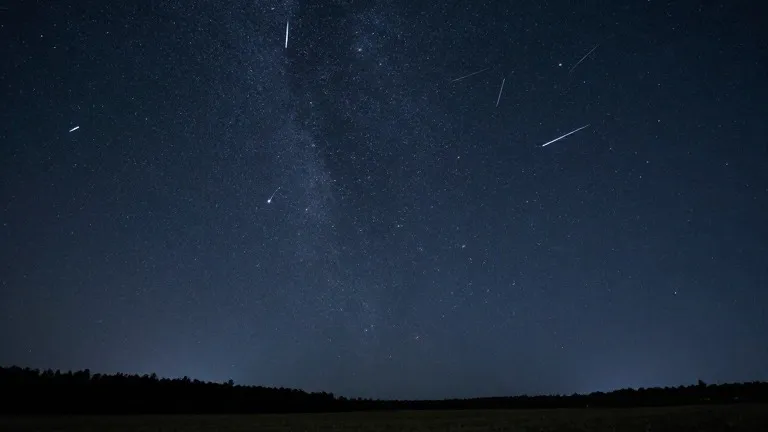
Tim McCollum photographed three distinct meteor trails from the Orionid shower over Toccoa, Georgia, on Oct. 21. The image captures glowing streaks generated by debris from Comet 1P/Halley, which is currently situated more than 3 billion miles from Earth. The particles visible in the composite are remnants of the comet's passage, producing light as they enter the atmosphere at high velocity.
The Orionid shower occurs annually as Earth intersects the dust trail left by Halley's Comet. Activity for this year's event built steadily through the middle of the month. McCollum recorded the specific trails between 3 a.m. and 4 a.m. on Oct. 21. This timing placed the capture just two days before the period of highest expected meteor rates.
McCollum used a Canon EOS Ra camera paired with an RF 28-70 f2.0 lens to record the event. He employed a star tracker to keep the sensor aligned with the shower's radiant point near the red giant star Betelgeuse. The photographer took multiple 30-second exposures and merged the resulting frames into a single composite image using PixInsight software.
The final image displays the three meteors radiating outward from a specific point in the constellation Orion. The frame also includes the stars of Orion's Belt and the Orion Nebula on the right side. The Rosette Nebula, catalogued as Caldwell 49, appears within the dense starfield of the Milky Way's galactic plane. Additional star clusters are visible against the dark background of the galactic dust lanes.
The annual display will continue for approximately two more weeks. The Orionids remain active until Nov. 7, providing observers with additional opportunities to view meteor activity. Earth is also passing through debris streams from Comet 2P/Encke during this period. These streams create the Taurid meteor shower, which occasionally produces large fireballs near Halloween.
McCollum's composite demonstrates the interaction between the Earth's orbit and the debris field of a short-period comet. The visual record confirms that material shed by Halley's Comet remains detectable in the atmosphere decades after its release. The image serves as a technical example of how long-exposure astrophotography can capture transient atmospheric events alongside fixed deep-sky objects.